CT DOC Video captures last moments of inmate before 2018 death
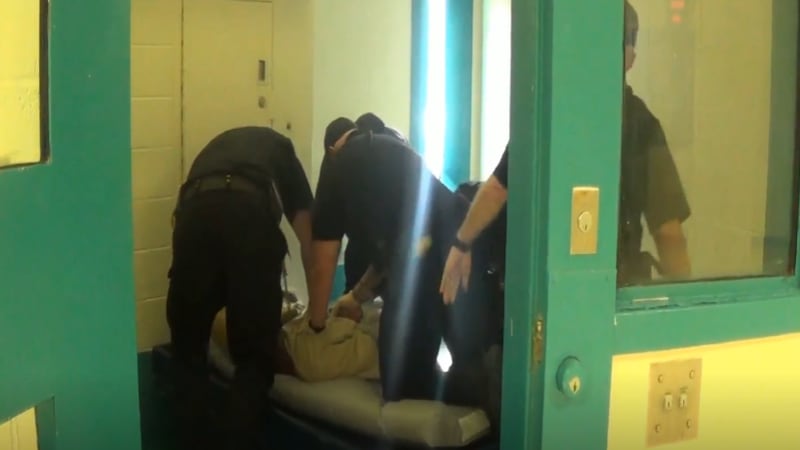
(WFSB) - Newly released and redacted video footage shows the final moments of 31-year-old J’Allen Jones, who died in a March 25, 2018 confrontation at the Garner Correctional Institution in Newtown, Connecticut.
Jones, diagnosed with schizophrenia, was serving a 10-year sentence for armed robbery at the time.
A Hartford judge signed off on the public release of the video Friday, following a years-long legal battle between Jones’ family and the state, over proposed redactions to the video.
Jones’ death had been ruled a homicide by the Medical Examiner. The state’s attorney declined to move forward with criminal charges.
What the video shows
At the beginning of the nearly one hour video, you can see that Jones is calm as he is escorted, in scrubs and handcuffs, to a cell for a routine strip search before receiving mental health services.
Upon arriving at Jones’ cell, staff begin performing the strip search. Jones appears to become frustrated, and starts yelling. He continues to yell as several correctional officers appear to restrain him, and Jones appears to resist.
Video shows Jones is forced onto his stomach on his bed, and several staff members kneel on him to hold him down.
ones is then pepper sprayed, stripped of his clothes and restricted by a spit guard placed around his neck. He is heard asking for water and wheezing.
Up to nine staff members can be seen trying to restrain Jones. There appear to be medical personnel present in the video but they do not immediately intervene.
An internal Department of Correction Review reports that Jones was medically distressed for over seven minutes before anyone attempted to offer help.
When staff tried standing Jones up to take him to a cell, he was unresponsive, so they put him in a wheelchair.
A few minutes later, Jones is seen unmoving while being rolled out of the room naked in that wheelchair, with what appears to be a bloodied spit veil over his head.
Staff acknowledge Jones is unconscious, and one officer voices concern for Jones’ health, calling him “dead weight.” Staff then do CPR for around 20 minutes.
Jones was taken to Danbury Hospital, where he was pronounced dead.
Findings and reviews
The Chief Medical Examiner Jones’ death a homicide, citing “blunt trauma, “struggle and restraint and pepper spray exposure,” along with hypertension and cardiovascular disease.
But a review by the Connecticut State Police in 2018 found no criminal wrongdoing by correctional staff, and an internal DOC review found that staff did not violate the use of force policy.
Attorney Ron Murphy, who represents the Jones’ family in the civil case, said in a statement Friday:
“The video speaks for itself so I’m not going to make any substantive comments right now. What I will say is I hope everyone who chooses to watch the video does so with an open heart, remembering that J’Allen Jones was a father and a son and that his family grieves every day. I also hope that people contact their elected officials to make their voices heard if, after watching, they believe changes need to be made. One more thing. I found the video very difficult to watch as it depicts the painful death of another human being. So please take care of yourself while watching and if you experience overwhelming feelings, consider taking a break or reaching out to someone for support.”
Department of Correction responds
Sharonda Carlos, Interim Commissioner of the Department of Correction, issued a statement Friday.
“Any loss of life in our facilities is a tragedy that we feel deeply, and our sympathy remains with Mr. Jones’ family and loved ones,” Carlos said.
Carlos said the department works to address pre-existing medical and mental health conditions among those in its care and is working to enhance mental health support, including hiring additional staff.
In May, Carlos said she appointed Dr. Craig Burns, an experienced psychiatrist with a focus on patients in correctional facility settings, to serve as Executive Director of Inmate Medical Services.
Carlos outlined several steps the department is taking, including rolling out enhanced mental health training, implementing multidisciplinary resource teams trained to build healthier facility environments, and embedding staff wellness programming throughout pre-service training.
“Behind every individual in our care is a family hoping for their well-being, and we do not take that responsibility lightly,” Carlos said. “We are committed to doing the continuous work of building a system that offers the support and dignity everyone in our care deserves.”
Correction Ombudsman responds
DeVaughn L. Ward, Esquire, the Correction Ombudsman, also issued a statement Friday.
“Today, my thoughts are with the family of J’Allen Jones,” Ward said. “Their courage in continuing to stand up for him, and in allowing the public to see what happened to their loved one, deserves to be acknowledged. This video is painful to watch, and it raises serious questions about force, restraint, medical response, transparency, and accountability inside our correctional system.”
Ward noted that the incident occurred in 2018, before Connecticut passed laws creating the Office of the Correction Ombuds and establishing the current Office of the Inspector General framework for investigating in-custody deaths.
“If an incident like this occurred today, the Office of the Inspector General and the Office of the Correction Ombuds would both have authority to conduct independent reviews,” Ward said. “The Inspector General’s Office would have authority to investigate the death and, where supported by law and evidence, pursue or refer criminal accountability. The Ombuds Office would also be empowered to independently review the incident, examine systemic issues, and make recommendations to the Department, the Governor, and the General Assembly.”
Ward said his office conducted an inquiry upon learning about the incident, and noted that many of the officers involved are no longer employed by the Department of Correction and that the prosecutor who declined charges has since retired.
“But those facts do not erase the need for public accountability,” Ward said. “It should not take this many years for a family, or the public, to receive answers about why a person died in state custody, or why the state spent years defending conduct that the public had not been able to fully see for itself.”
Ward said he advocated in 2025 for a provision that would have allowed the Correction Ombuds or the Inspector General to release footage publicly when there is a death in custody.
That proposal was narrowed to allow the family and the Judiciary Committee chairs to view the footage.
“That was a step forward, but this case shows we can do more,” Ward said. “Transparency is not about assigning blame before the facts are known. It is about public trust. When someone dies in state custody, the public deserves timely, independent answers, and families deserve a process that does not require them to fight for years simply to have the truth seen.”
Attorney General’s office
The Office of the Attorney General represented the state in the legal battle over the video’s release.
Per statute, the Attorney General is required to defend the state and does not oversee the Department of Correction.
The Attorney General said in a statement: “What happened to Mr. Jones is a tragedy. For any human being, this is difficult and painful to watch.”
Copyright 2026 WFSB. All rights reserved.